💡Quick Summary
In a world entirely dependent on digital connectivity, networks are no longer just an internet service; they have become the backbone of all modern systems, from security cameras to administrative systems.
Whether you are a smart home owner or a business, the strength of your network is the primary factor that determines the efficiency of all other systems.
In this article, we explain everything you need to know about internet networks and infrastructure in a practical and clear way.
What is meant by network infrastructure?
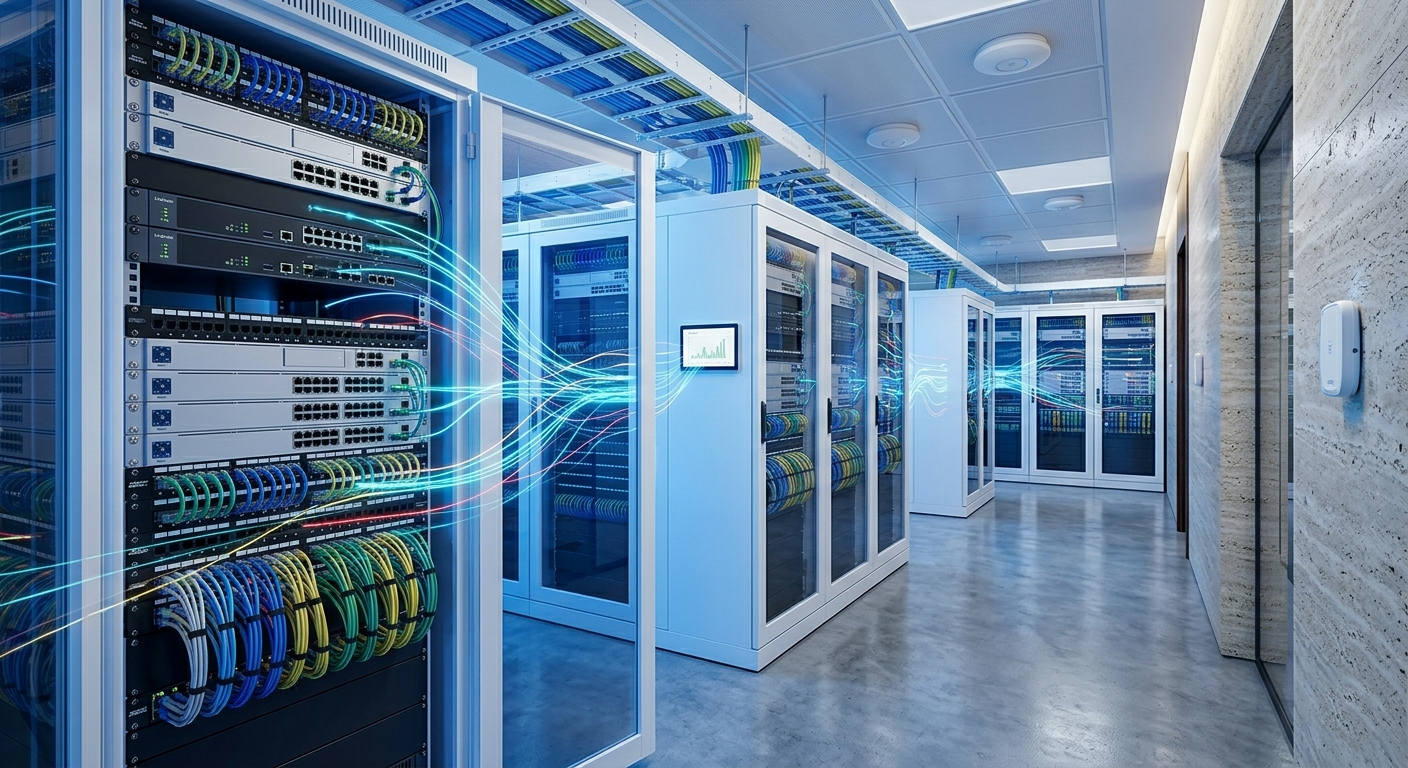
Network infrastructure refers to everything related to establishing and operating a stable internal internet network, including:
- Network cable extensions
- Distribution devices (Router / Switch)
- Wi-Fi Access Points
- Server rooms
- Cable management systems
Why is the network more important than the devices themselves?
Many clients focus on buying powerful devices but overlook the network. 📌 The Truth: Even the best cameras or systems will not work efficiently without a strong network.
A good network ensures:
- Stable connection speed
- No system interruptions
- High broadcasting quality
- Instant device response
Where do you need professional infrastructure?
- Companies and offices
- Warehouses
- Commercial stores
- Large villas
- New projects
Professional Network Components
🔹 1. Network Cabling
- The primary backbone of the network.
- It is preferable to use high-quality cables (Cat6 or higher).
- Organized extension inside walls or designated conduits.
🔹 2. Switch
- Connects all devices within the network.
- Distributes the connection professionally.
- Suitable for medium and large projects.
🔹 3. Router
- The internet connection point.
- Controls network distribution.
- Manages the external connection.
🔹 4. Wi-Fi Access Points
- Distributes the internet within the site.
- Complete coverage without interruption.
- Reduces signal weakness.
🔹 5. Rack / Server Room
- Organizes devices and cables.
- Protects equipment.
- Facilitates maintenance.
How to improve Wi-Fi coverage?
If you suffer from weak internet:
Solutions:
- Distribute Wi-Fi points correctly.
- Use Access Points instead of traditional extenders.
- Reduce obstacles (thick walls).
- Adjust network settings.
Difference Between Home and Commercial Networks
| Element | Home | Commercial |
|---|---|---|
| Number of Users | Low | High |
| Network Load | Low | High |
| Need for Stability | Medium | Very High |
| Infrastructure | Simple | Professional |
Common Network Mistakes
❌ Using cheap devices: Leads to poor performance and continuous interruptions.
❌ Poor distribution of Wi-Fi points: Creates dead zones without coverage.
❌ Lack of cable organization: Makes maintenance difficult and affects quality.
❌ Lack of advance planning: Especially in new projects.
How to choose the right network for you?
Ask yourself:
- How many users are there?
- What is the site area?
- Are there systems relying on the network (Cameras / PBX)?
- Do you need high speed or long-term stability?
Are networks connected to security systems?
Yes, directly 👇
- Cameras need a strong network for broadcasting.
- Smart systems rely on connectivity.
- PBX needs constant stability.
📌 Therefore, it is best to implement an integrated solution (Network + Systems).
Steps to establish a professional network
- Site survey
- Determine network points
- Extend cables
- Install devices
- Configure settings
- Performance testing
The Future of Networks in Saudi Arabia
With digital transformation:
- Spread of optical fibers (Fiber optics)
- Increased reliance on smart systems
- Growth of digital businesses
- Expansion of smart cities
Conclusion
The network is not just the internet… It is the foundation upon which everything relies. The more your network is:
- Organized
- Strong
- Properly designed
The better performance you will get for all your systems.